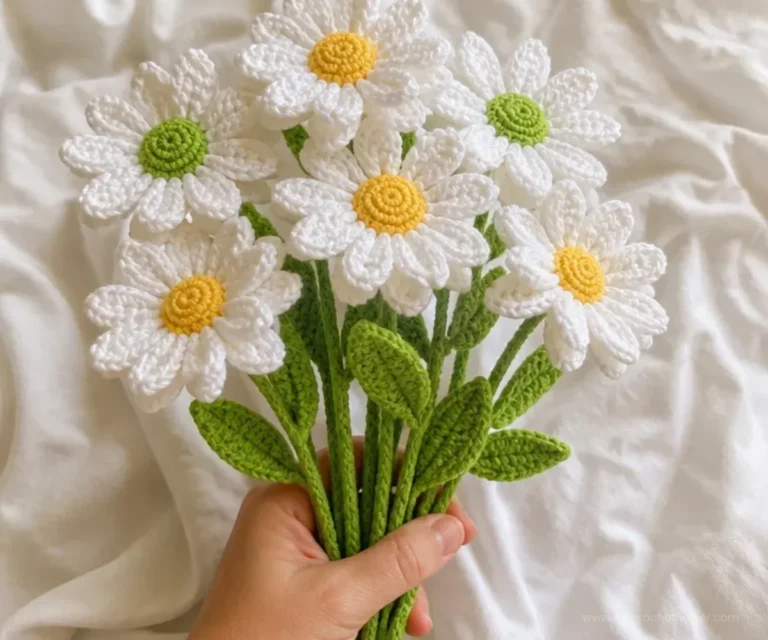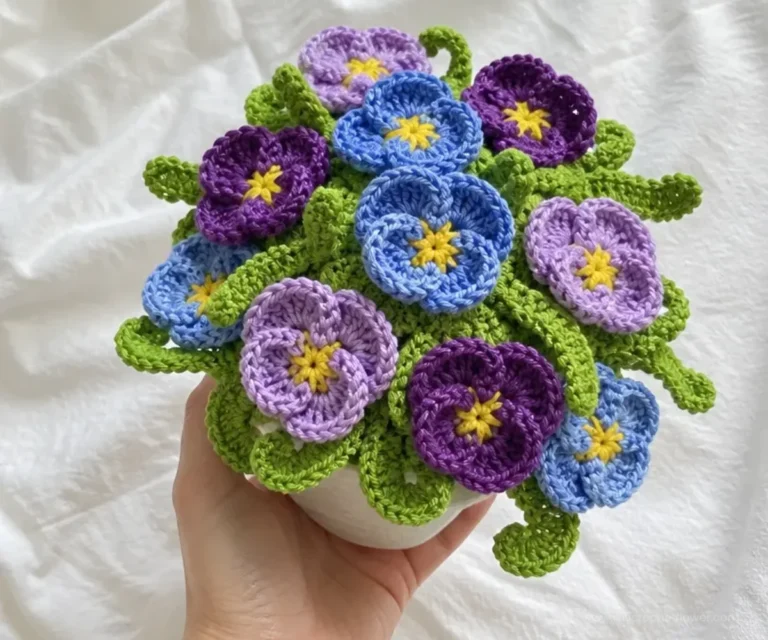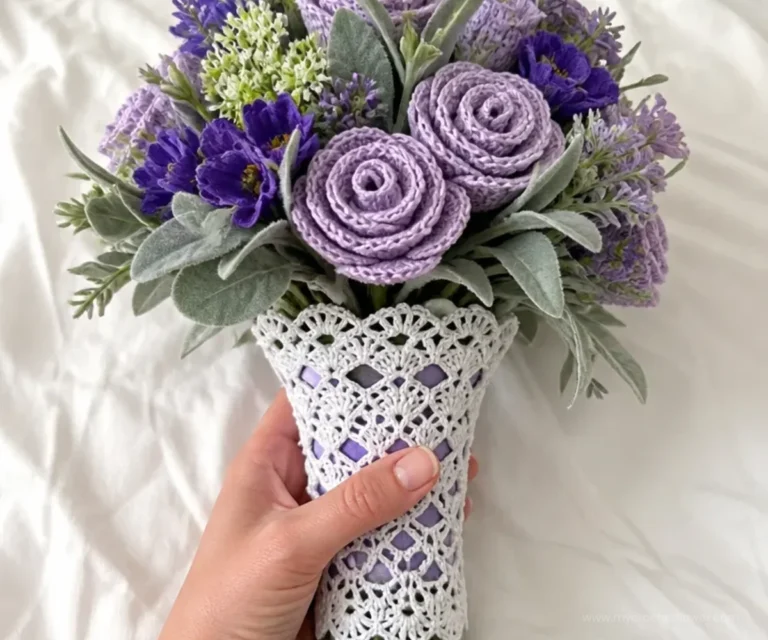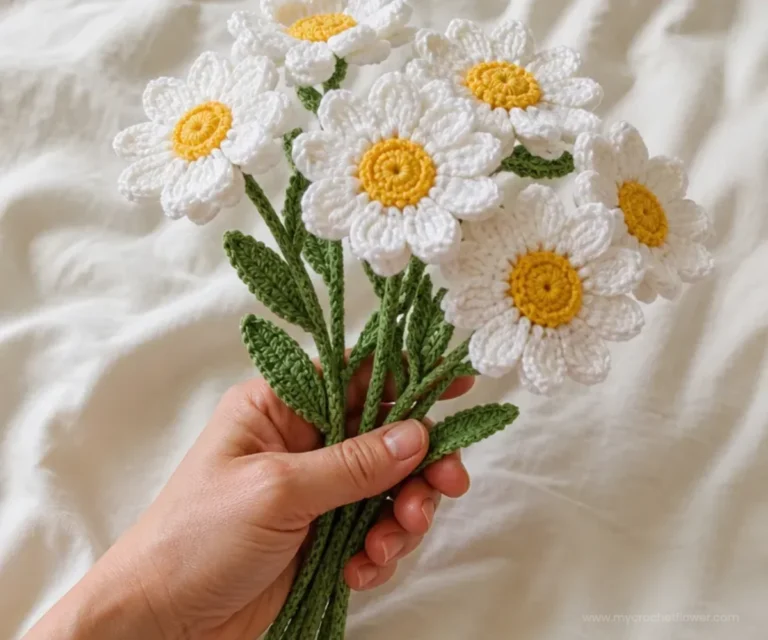


A handmade rose bouquet brings lasting color to a room without watering or wilting. This Rose Bouquet Pattern creates a 15-flower arrangement from layered full roses, smaller buds, crocheted stems, and leaves. Strawberry, rose pink, hot pink, and hot green yarn give the bouquet a cheerful garden-inspired palette. The project is a practical choice for crocheters who enjoy making floral gifts, seasonal décor, or reusable centerpieces. For another flower-arrangement idea, compare the construction with this crochet rose bouquet pattern.
Why You’ll Love This Crochet Project

- It creates a complete bouquet. The pattern includes 15 stems, 30 leaves, nine full flowers, and six flower buds.
- The layered petals add dimension. Each full flower builds from progressively larger petal rounds, giving the roses a full, sculptural shape.
- It offers color variety. Strawberry, Rose Pink, and Hot Pink can be arranged together for a multicolored bouquet.
- It develops useful skills. You will practice working into rings, crocheting behind previous rounds, shaping petals, working in back loops, and assembling wired stems.
- It makes a lasting gift. The finished flowers can be displayed in a vase, used as a table accent, or given for birthdays, anniversaries, and spring celebrations.
My Crochet Flower Tip: Make one full flower and one bud first so you can become comfortable with the petal spacing and color changes before completing the entire bouquet.
How This Crochet Project Comes Together
The bouquet is made in separate components and assembled at the end:
- Make three full flowers in each of MC, Contrast A, and Contrast B.
- Make two flower buds in each of MC, Contrast A, and Contrast B.
- Crochet 15 green stems.
- Crochet 30 green leaves.
- Weave floral wire through the stems, sew two leaves to each stem, and attach a full flower or bud to each stem end.
The full flower is built from a small center ring and seven rounds. Petal rounds alternate with chain-loop rounds worked behind the preceding petals. The flower bud begins with a small group of single crochet stitches, then develops three smaller petals.
The pattern uses US crochet terminology. Helpful abbreviations include:
- Ch: chain
- Sc: single crochet
- Hdc: half double crochet
- Dc: double crochet
- Tr: treble crochet
- Sl st: slip stitch
- Rep: repeat
- Sp(s): space(s)
Materials You’ll Need
- Lily® Sugar ’n Cream Solids: 70.9 g / 2.5 oz, 109 m / 120 yds
- Lily® Sugar ’n Cream Ombres: 56.7 g / 2 oz, 86 m / 95 yds
- Main Color (MC), 00144 Strawberry: 1 ball
- Contrast A, 00046 Rose Pink: 1 ball
- Contrast B, 01740 Hot Pink: 1 ball
- Contrast C, 01712 Hot Green: 2 balls
- Size 4 mm (U.S. G or 6) crochet hook, or size needed to obtain gauge
- Light green floral wire
The green yarn is used for the buds’ beginning rounds, stems, and leaves. Floral wire gives each crocheted stem support so the flowers can stand in a vase and be arranged.

Step-by-Step Crochet Instructions
Stitch Glossary and Abbreviations
- Beg: beginning
- Ch: chain(s)
- Dc: double crochet
- Rep: repeat
- RS: right side
- Sc: single crochet
- Sl st: slip stitch
- Sp(s): space(s)
- St(s): stitch(es)
- Tog: together
- Tr: treble crochet
- WS: wrong side
- Yoh: yarn over hook
Full Flower
Make 3 each with MC, A, and B. The rose is complete when its center is closed.
Chain 4, leaving a long end to use for gathering the center closed when the rose is complete. Join with a slip stitch in the first chain to form a ring.
1st rnd: Chain 1. Work
(2 sc, 2 hdc, 2 dc, 3 tr)all in the ring. Join with a slip stitch in the first single crochet.2nd rnd working behind 1st rnd: Chain 1. Slip stitch between the first 2 single crochet stitches. Chain 3. Slip stitch between the next 2 half double crochet stitches. Chain 3. Slip stitch between the next 2 double crochet stitches. Chain 3. Slip stitch between the next 2 treble crochet stitches. Chain 3. Slip stitch after the last treble crochet. Chain 3. Join with a slip stitch to the first single crochet. You now have 5 chain-3 loops.
3rd rnd: Repeat the following around:
Ch 1, (5 dc, sl st) in next ch-3 loop.Join with a slip stitch in the first chain 1. You now have 5 petals.4th rnd working behind last rnd: Chain 1. Work 1 single crochet in the same space as the last slip stitch. Repeat the following 3 times more:
Ch 5, sl st in sp between next 2 petals.Chain 5. Join with a slip stitch in the first single crochet. You now have 5 chain-5 loops.5th rnd: Repeat the following around:
Ch 1, (2 dc, 4 tr, 2 dc, sl st) in next ch-5 loop.Join with a slip stitch in the first chain 1. You now have 5 petals.6th rnd working behind last rnd: Chain 1. Work 1 single crochet in the same space as the last slip stitch. Repeat the following 3 times more:
Ch 7, sl st in sp between next 2 petals.Chain 7. Join with a slip stitch in the first single crochet. You now have 5 chain-7 loops.7th rnd: Repeat the following around:
Ch 1, (3 dc, 5 tr, 3 dc, sl st) in next ch-7 loop.Join with a slip stitch in the first chain 1. You now have 5 petals. Fasten off.
Full Flower Center Closing
Thread the end at the starting ring onto a tapestry needle and gather the center together tightly to close the flower.
Flower Bud
Make 2 each with MC, A, and B.
With C, chain 2.
1st rnd: Work 5 single crochet in the 2nd chain from the hook. Join with a slip stitch in the first single crochet.
2nd rnd: Chain 1. Work
(2 sc in next sc, 1 sc in next sc)twice. Work 2 single crochet in the last single crochet. Join with a slip stitch in the first single crochet. You have 8 single crochet.3rd rnd: Chain 1. Work
(2 sc in next sc, 1 sc in next sc)4 times. Join MC, A, or B with a slip stitch in the first single crochet. You have 12 single crochet. Break C.4th rnd with MC, A, or B: Chain 1. Working in the back loop only of each single crochet, work 1 single crochet in the same space as the last slip stitch. Work 1 single crochet in each single crochet around. Join with a slip stitch to the first single crochet.
5th rnd: Chain 1. Work 1 single crochet in the same space as the last slip stitch. Repeat the following twice more:
Miss next sc. 5 sc in next sc shell made. Miss next sc. 1 sc in next sc.Miss the next single crochet. Work a shell in the next single crochet. Miss the next single crochet. Join with a slip stitch in the first single crochet.6th rnd working behind last rnd: Chain 1. Work 1 single crochet in the same space as the last slip stitch. Repeat the following once more:
Ch 4, sl st in sp between next 2 petals.Chain 4. Join with a slip stitch in the first single crochet. You now have 3 chain-4 loops.7th rnd: Repeat the following around:
Ch 1, (4 dc, 1 hdc, 1 sc, sl st) in next ch-4 loop.Join with a slip stitch in the first chain 1. Fasten off.
Stems
Make 15.
With C, chain 51.
1st row: Work 1 single crochet in the 2nd chain from the hook. Work 1 single crochet in each chain to the end of the chain. You have 50 single crochet. Fasten off.
Leaves
Make 30.
With C, chain 5.
1st rnd: Work 1 single crochet in the 2nd chain from the hook, 1 half double crochet in the next chain, and 1 double crochet in the next chain. Work 5 double crochet in the last chain.
Working into the opposite side of the chain and into the remaining loops, work 1 double crochet in the next chain, 1 half double crochet in the next chain, and 1 single crochet in the last chain. Join with a slip stitch to the first single crochet. Fasten off.
Assembly and Finishing
- Cut floral wire in lengths to fit the stems and weave it through each stem.
- Sew 2 leaves to each stem.
- Attach full flowers or flower buds to the stem end.
For a smaller floral accessory using similar rose-inspired shaping, you may also enjoy this crochet felted rose pin pattern.
Ways to Display Your Finished Crochet

- Classic vase arrangement: Arrange the 15 wired stems at varied heights in a narrow vase so the full roses form the center and buds fill the outer edges.
- Table centerpiece: Place the bouquet in a low container and gently spread the leaves around the flowers for a compact dining-table display.
- Handmade gift: Present the bouquet as a lasting birthday, anniversary, housewarming, or graduation gift.
- Seasonal décor: Use the Strawberry, Rose Pink, and Hot Pink palette for spring and summer displays, or reorganize the colors for other seasons.
- Wedding-inspired arrangement: Coordinate the flower colors with an event palette and use the bouquet as a decorative accent.
- Mixed crochet garden: Pair this bouquet with another floral design, such as a crochet daffodil bouquet, for a varied handmade arrangement.
Caring for Your Crochet Project
- Dust the bouquet gently with a soft brush, feather duster, or cool air from a hair dryer held well away from the flowers.
- For a small mark, spot clean carefully with a lightly damp cloth rather than soaking the bouquet.
- Avoid machine washing and prolonged water exposure because the stems contain floral wire.
- Reshape petals and leaves gently with your fingers after handling.
- Keep the bouquet away from excessive heat, open flames, and prolonged direct sunlight.
- Store it upright or loosely wrapped in clean tissue paper so the petals are not crushed.
- When transporting it, support the stems and avoid placing heavy objects on the flowers.
Tips for Better Results
- Leave the long starting end on every full flower. That end is specifically used to gather the center closed after the final petal round.
- Watch the working position. The chain-loop rounds are worked behind the previous petal round, which allows the layers to build outward.
- Count the loops and petals. The full flower should have 5 chain-3 loops, 5 petals, 5 chain-5 loops, 5 petals, 5 chain-7 loops, and 5 final petals.
- Use the back loop only where instructed. The fourth round of the bud is worked in the back loop only of each single crochet; changing placement can alter the bud’s edge.
- Keep the color changes organized. The bud begins with C, changes to MC, A, or B on the 3rd round, and breaks C after that round.
- Check the stem count before assembly. Fifteen stems are needed for the bouquet, with two leaves sewn to each stem.
- Handle floral wire safely. Cut wire carefully, bend or cover sharp ends, and weave it through the crocheted stem so it does not protrude.
- Secure attachments firmly. Sew the leaves to the stems and attach each flower or bud to the stem end before arranging the bouquet.
A garland is another way to use rose motifs decoratively; see this crochet rose garland pattern for a related project idea.
Color and Styling Variations
These are optional styling ideas and do not change the approved instructions:
- Use Strawberry for all full flowers and reserve Rose Pink or Hot Pink for buds to create a coordinated arrangement.
- Alternate the three flower colors evenly so the bouquet has balanced color distribution.
- Arrange the flowers in a monochromatic palette by using one approved flower color throughout.
- Pair the bright flowers with a simple white, glass, or natural-toned vase so the petals remain the visual focus.
- Shape the wired stems into a rounded bouquet, a taller vertical arrangement, or a gently asymmetrical display.
- Combine this rose bouquet with other crocheted flowers for a fuller botanical centerpiece.
If you substitute yarn or change the hook size, the petal size, stem length, texture, and yarn requirements may change. Work a small test piece before making the complete bouquet and use the hook size needed to obtain gauge.
Frequently Asked Questions
Is this pattern suitable for a beginner?
It is suitable for a crocheter who is comfortable with basic stitches, slip-stitch joins, working in rounds, and reading repeat instructions. The full flowers also introduce treble crochet and chain-loop construction.
How many flowers does the bouquet include?
The bouquet includes 15 flowers: 9 full flowers and 6 flower buds. The full flowers are made 3 each in MC, A, and B, while the buds are made 2 each in MC, A, and B.
How many stems and leaves are required?
Make 15 stems and 30 leaves. The finishing instructions specify sewing 2 leaves to each stem.
Can I change the flower colors?
Yes. The approved color arrangement uses Strawberry, Rose Pink, and Hot Pink for the flowers, but you may assign those colors differently or use a coordinated palette. Changing yarn can affect the finished texture and size.
What hook size is recommended?
Use a size 4 mm (U.S. G or 6) crochet hook, or the size needed to obtain gauge.
Why is floral wire woven into the stems?
The wire supports the crocheted stems and allows you to arrange the flowers in a vase. Handle the wire carefully and make sure no sharp end protrudes through the crochet.
How do I close the center of a full flower?
Thread the end at the starting ring onto a tapestry needle and gather the center together tightly to close the flower.
Can the finished bouquet be washed?
Because the stems contain floral wire, avoid machine washing and soaking. Dust gently and spot clean carefully when needed.
Conclusion
This Rose Bouquet Pattern combines layered roses, smaller buds, leafy stems, and floral wire into a reusable handmade arrangement. The bright color palette makes it suitable for gifts, centerpieces, and seasonal décor, while the wired construction allows flexible styling. For more bouquet inspiration, explore this rose crochet flower blanket bouquet project and these free crochet flower bouquet patterns.