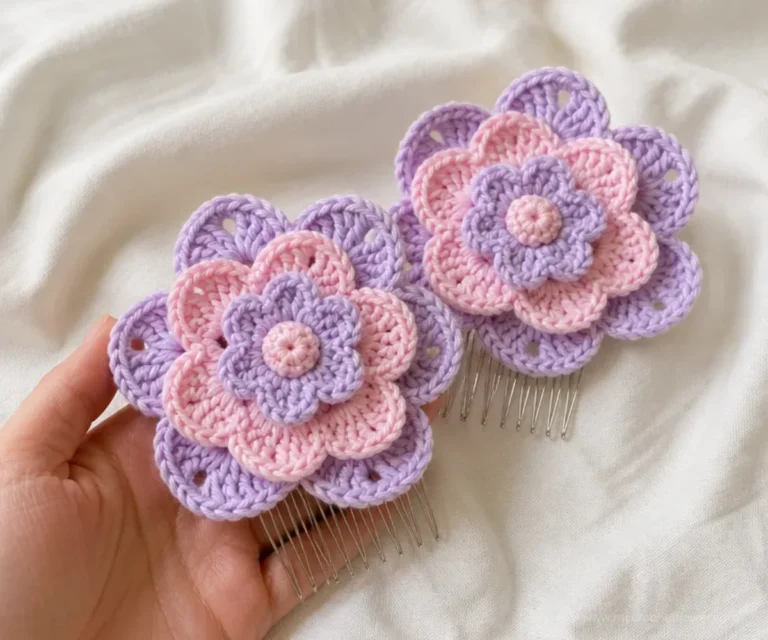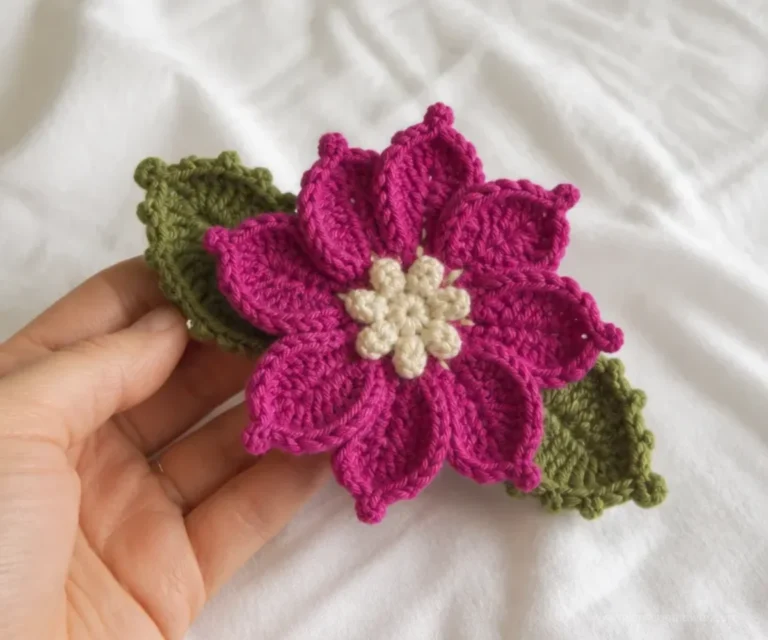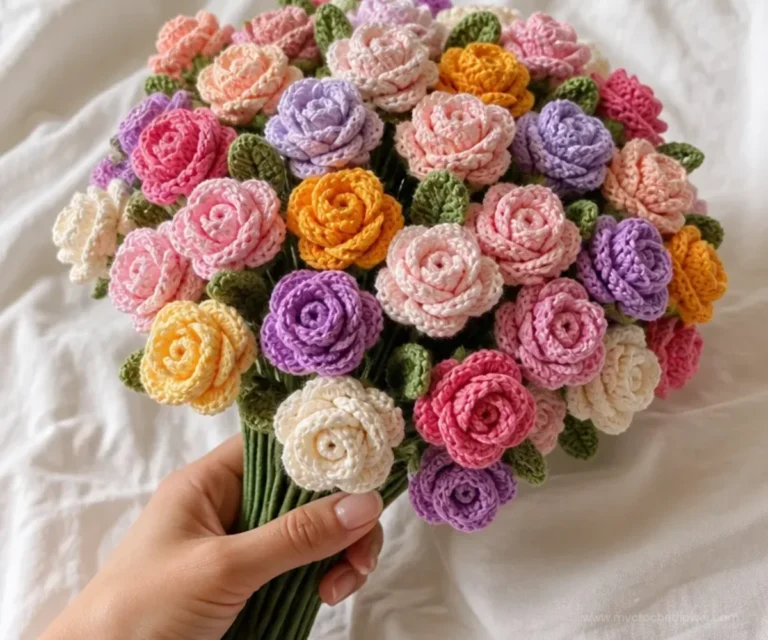

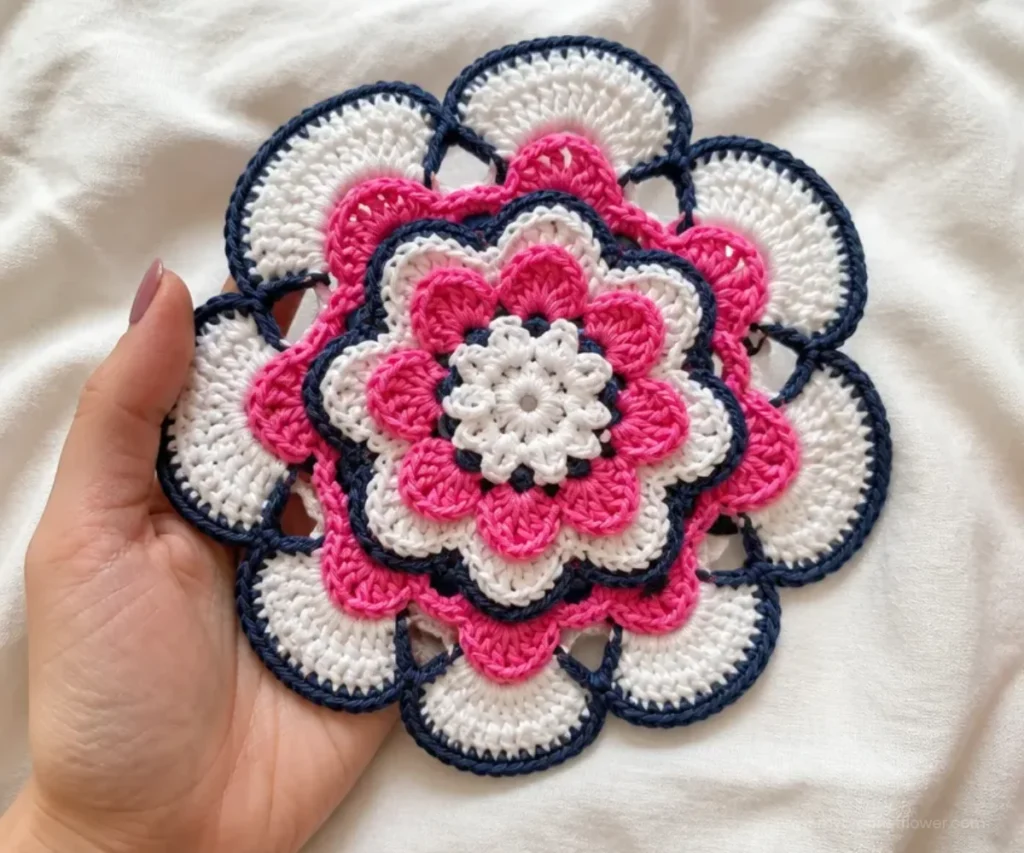
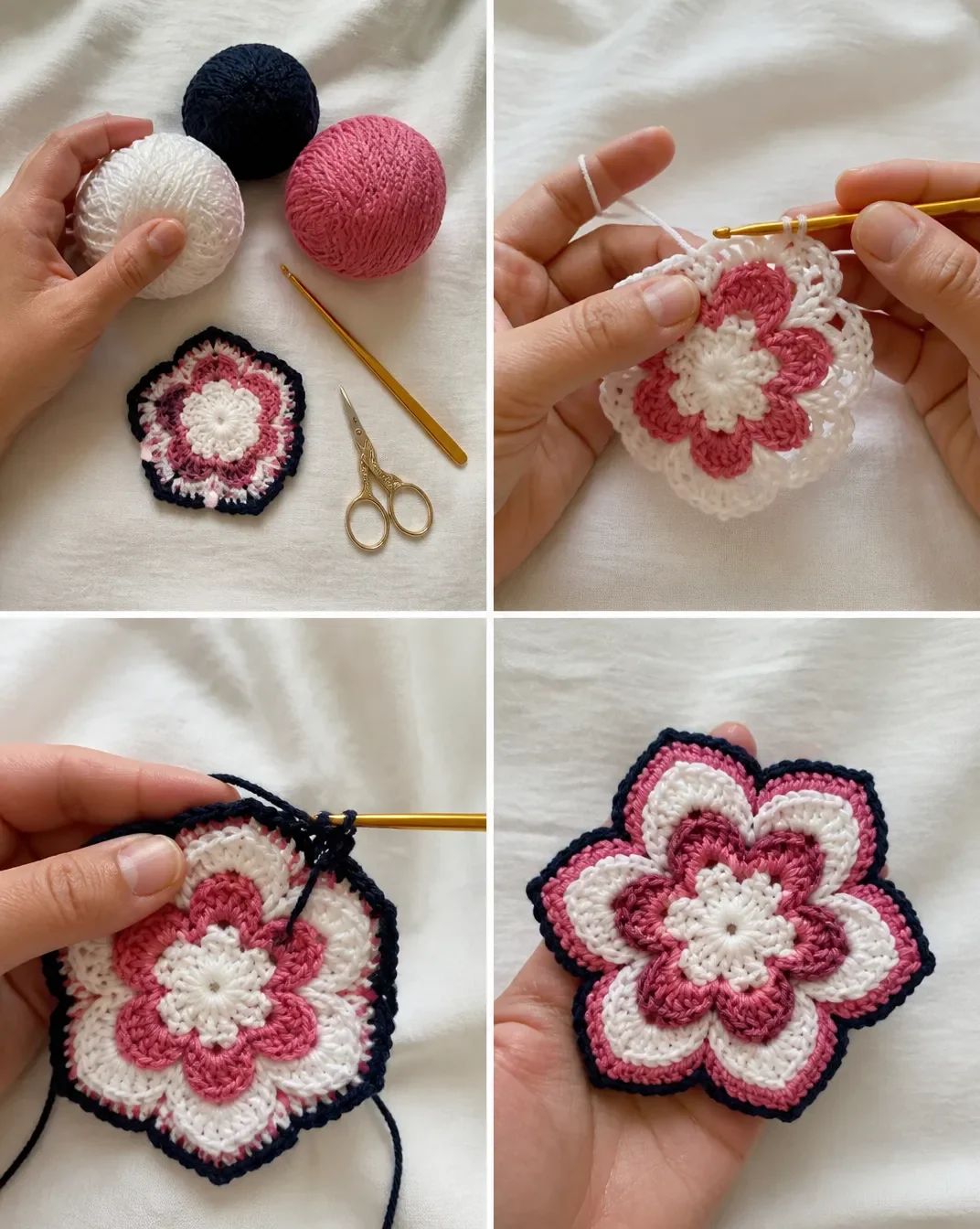
This layered crochet flower pattern creates a five-petal bloom with a textured center and several gradually enlarging petal rounds. Snow, Rose, and Night shades give the flower a crisp, graphic look, while the layered construction adds depth without requiring separate leaves, stems, or assembly. It is a lovely project for handmade floral decorations, gift wrapping, table displays, or a crochet flower bouquet. Because the pattern uses familiar stitches alongside picots and behind-the-work chains, it also offers useful practice for crocheters building confidence.
Why You’ll Love This Crochet Project

- Layered floral texture: The petals grow from small inner rounds to larger outer rounds, creating a dimensional flower rather than a flat motif.
- Colorful but coordinated: Snow forms the main color, Rose adds contrast to selected petal rounds, and Night provides a defined edging.
- Useful stitch practice: You will work single crochet, half double crochet, double crochet, treble crochet, chains, slip stitches, and picots.
- Flexible decorating potential: The finished crochet flower can stand alone as an embellishment or become part of a larger handmade floral display.
- A satisfying repeat structure: Each petal round follows a five-petal rhythm, making it easier to recognize the shape as it develops.
My Crochet Flower Tip: Keep the flower flat while completing each round, but do not stretch the petals aggressively. Gentle shaping after fastening off will help the layered petals sit neatly.
Pattern Overview
This crochet flower begins with a small ring made in the main color, Snow. The first rounds create the center and five small spaces. Contrast A is then used for one petal layer, while the main color returns for the next. The pattern alternates these colors as the flower expands.
The construction follows this sequence:
- Make the center ring and the first five small spaces.
- Work the first petal layer in Contrast A.
- Create behind-the-work chain spaces for the next petal layer.
- Work progressively larger petals through the tenth round.
- Add a Night-colored single crochet edging around the petals.
- Repeat the petal treatment for the remaining petals where specified in the pattern.
The design relies on working behind earlier petals and into chain spaces from previous rounds. This is what allows the new petal layers to sit behind the existing ones instead of covering them completely.
Useful Abbreviations
- ch: chain
- sc: single crochet
- hdc: half double crochet
- dc: double crochet
- tr: treble crochet
- sl st: slip stitch
- rnd: round
- MC: main color
- Rep: repeat
A picot in this pattern is made by chaining 3 and slip stitching in the third chain from the hook.
Materials You’ll Need
- Patons® Grace, 50 g/1.75 oz
- Main Color (MC), 60005 Snow: 1 ball
- Contrast A, 60437 Rose: 1 ball
- Contrast B, 60040 Night: 1 ball
The pattern information supplied does not specify a crochet hook size or additional tools. Use the hook size you normally pair with this yarn while maintaining an even, comfortable tension.
Step-by-Step Crochet Instructions
The instructions below preserve the supplied pattern sequence and terminology. Work each round carefully, especially where the pattern directs you to work behind a previous petal layer.
Flower Center
Starting
With MC, ch 3. Join with sl st to form a ring.
1st rnd
Ch 1.
10 hdc in ring.
Join with sl st to first hdc.
(No explicit stitch count given; follow as written.)
2nd rnd
Ch 1.
1 sc in same sp as last sl st.
Ch 3. Sl st in 3rd ch from hook – Picot made.
Miss next sc.
1 sc in next sc.
Rep from * 3 times more.
Picot.
Miss last sc.
Join with sl st to first sc.
3rd rnd
Ch 1.
Working behind Picot, 1 sc in next missed sc of 2nd rnd.
Ch 2.
Rep from * 4 times more.
Join with sl st to first sc.
5 Petals.
Fasten off.
First Petal Layer
4th rnd
Join A with sl st to any ch-2 sp.
Ch 1.
(1 sc. 4 dc. 1 sc) in same sp.
[(1 sc. 4 dc. 1 sc) in next ch-2 sp] 4 times.
Join with sl st to first sc.
5 Petals.
5th rnd
Ch 2 (does not count as st).
Working from back to front behind last rnd, 1 sc in next ch-2 sp of 3rd rnd between center 2 dc.
Ch 3.
Rep from * 4 times more.
Miss first ch-2 sp.
Join with sl st to next sc.
Fasten off.
Second Petal Layer
6th rnd
Join MC with sl st to any ch-3 sp.
Ch 1.
(1 sc. 6 dc. 1 sc) in same sp.
[(1 sc. 6 dc. 1 sc) in next ch-3 sp] 4 times.
Join with sl st to first sc.
5 Petals.
7th rnd
Ch 3 (does not count as st).
Working from back to front behind last rnd, 1 sc in next ch-3 sp of 5th rnd between center 2 dc.
Ch 4.
Rep from * 4 times more.
Miss first ch 3.
Join with sl st to next sc.
Fasten off.
Third Petal Layer
8th rnd
Join A with sl st to any ch-4 sp.
Ch 1.
(1 sc. 1 dc. 4 tr. 1 dc. 1 sc) in same ch-4 sp.
[(1 sc. 1 dc. 4 tr. 1 dc. 1 sc) in next ch-4 sp] 4 times.
Join with sl st to first sc.
5 Petals.
9th rnd
Ch 3 (does not count as st).
Working from back to front behind last rnd, 1 sc in ch-4 sp of 7th rnd between center 2 tr.
Ch 5.
Rep from * 4 times more.
Miss first ch 3.
Join with sl st to next sc.
Fasten off.
Outer Petal Layer
10th rnd
Join MC with sl st to any ch-5 sp.
Ch 1.
(1 sc. 2 dc. 6 tr. 2 dc. 1 sc) in same ch-5 sp.
[(1 sc. 2 dc. 6 tr. 2 dc. 1 sc) in next ch-5 sp] 4 times.
Join with sl st to first sc.
Fasten off.
5 Petals.
Edging
Join B with sl st to any sc of 4th rnd.
Work 1 sc in every st around edge of petals.
Join with sl st to first sc.
Fasten off.
Repeats / Petals
Rep for rem petals on rnds 6, 8 and 10.
Ways to Display Your Finished Crochet

- Create a vase arrangement: Combine several finished flowers in coordinating shades and place them in a small decorative vase.
- Make a table centerpiece: Arrange the flowers around a candle holder, bowl, or seasonal ornament.
- Decorate gift packaging: Sew or tie one flower to ribbon, a gift bag, or a wrapped parcel for a reusable embellishment.
- Build a seasonal display: Snow, Rose, and Night can work in a winter-inspired arrangement, while alternate palettes can suit spring or summer decor.
- Use a single flower as an accent: Attach one finished flower to a basket, cushion, fabric accessory, or display board, provided it is secured appropriately.
- Combine different flower sizes: Make coordinated flowers with carefully selected yarn and hook changes, remembering that altered materials can change the finished scale and texture.
Caring for Your Crochet Project
Keep the finished flower away from excessive moisture and rough handling. The layered petals and picot details can catch on jewelry, hook edges, or textured fabrics, so store the flower where it will not be compressed or snagged.
For routine cleaning, gently dust the petals with a soft, dry cloth or use light air from a distance. If a small area needs attention, use careful spot cleaning and avoid saturating the flower. Allow it to dry completely before storing or displaying it.
When the petals lose their shape, reshape them gently with your fingers. Avoid excessive heat, which can affect the yarn’s appearance and may flatten the dimensional petal layers. Store the flower in a dry container or shallow box with enough room to prevent the petals from being crushed.
Tips for Better Results
- Mark the beginning of each round if needed. The pattern joins each round with a slip stitch, and a removable marker can help you identify the first stitch or space.
- Keep the five-petal rhythm visible. Each petal round is built five times around the flower. Counting the completed petal groups can help you notice an accidental omission.
- Work carefully behind the previous layer. Rounds 5, 7, and 9 specifically direct you to work from back to front behind the last round. This placement creates the spaces for the next petals.
- Do not count the specified turning chains as stitches. The chains at the beginning of rounds 5, 7, and 9 are explicitly marked as not counting as stitches.
- Use the correct chain space for each layer. Round 6 uses ch-3 spaces, round 8 uses ch-4 spaces, and round 10 uses ch-5 spaces. Confusing these spaces can distort the petal sizes.
- Shape each petal as you go. After completing a group of stitches in a space, gently arrange the stitches so the taller center stitches form a rounded petal.
- Secure color changes neatly. Fasten off where instructed, then weave in ends carefully on the back of the flower so they do not show through the open spaces.
- Check the edging placement. The Night edging begins at an sc of the 4th round and is worked around the edge of the petals, not around the entire center.
Color and Styling Variations
The approved pattern uses Snow as the main color, Rose as Contrast A, and Night as Contrast B. You can customize the appearance by changing the color arrangement while keeping the original stitch instructions unchanged.
- Use a soft cream main color with blush and sage-like accent shades for a gentle botanical palette.
- Try bright yellow, coral, and turquoise for a cheerful summer-inspired flower.
- Choose burgundy, rust, and deep brown or navy-style accents for an autumn display.
- Use one color throughout for a minimalist flower with emphasis on the layered texture.
- Make several flowers with different contrast combinations, then arrange them together for a varied bouquet.
- Pair the flower with a simple neutral vase so the petal colors remain the focal point.
These are optional styling ideas only. Substituting yarn or changing the hook size may affect tension, petal proportions, finished dimensions, texture, and yarn requirements. Make any material changes deliberately rather than treating them as identical replacements for the approved yarn.
Frequently Asked Questions
Is this crochet flower pattern beginner-friendly?
It is suitable for crocheters who are comfortable with basic stitches and joining rounds. Beginners should pay particular attention to picots, treble crochet, and the instructions for working behind earlier petal layers.
How many petals does the flower have?
The pattern identifies five petals in the flower’s petal rounds. The first completed petal layer is made in round 4, followed by progressively larger layers in rounds 6, 8, and 10.
What yarn is recommended?
The specified yarn is Patons® Grace, 50 g/1.75 oz, using one ball each of MC 60005 Snow, Contrast A 60437 Rose, and Contrast B 60040 Night.
Which color is used for the edging?
Contrast B, 60040 Night, is used for the edging. It is joined with a slip stitch to any single crochet of the 4th round, then single crochet is worked around the edge of the petals.
Can I change the colors?
Yes. Color changes are an optional customization. Keep the approved stitch sequence intact, and remember that different colors may change the mood and visual definition of the layered petals.
How do I keep the petals dimensional?
Work the taller stitches evenly and arrange each petal gently after completing its space. Avoid pulling the stitches too tightly, and reshape the flower carefully after the final edging.
Can I use another yarn?
You may choose another yarn as an optional variation, but it can affect tension, dimensions, texture, drape, and yarn requirements. A different yarn may also make the petal layers look more or less pronounced.
How should I store the finished flower?
Store it flat or in a roomy container where the petals will not be compressed. Keep it dry and protect the picots and outer edges from snagging.
Conclusion
This crochet flower pattern combines five-petal shaping, layered colorwork, picots, and dimensional stitches into an attractive handmade bloom. Follow the rounds carefully, especially the behind-the-work instructions, then display the finished flower on its own or as part of a bouquet. For more floral project inspiration, browse these free crochet flower patterns.